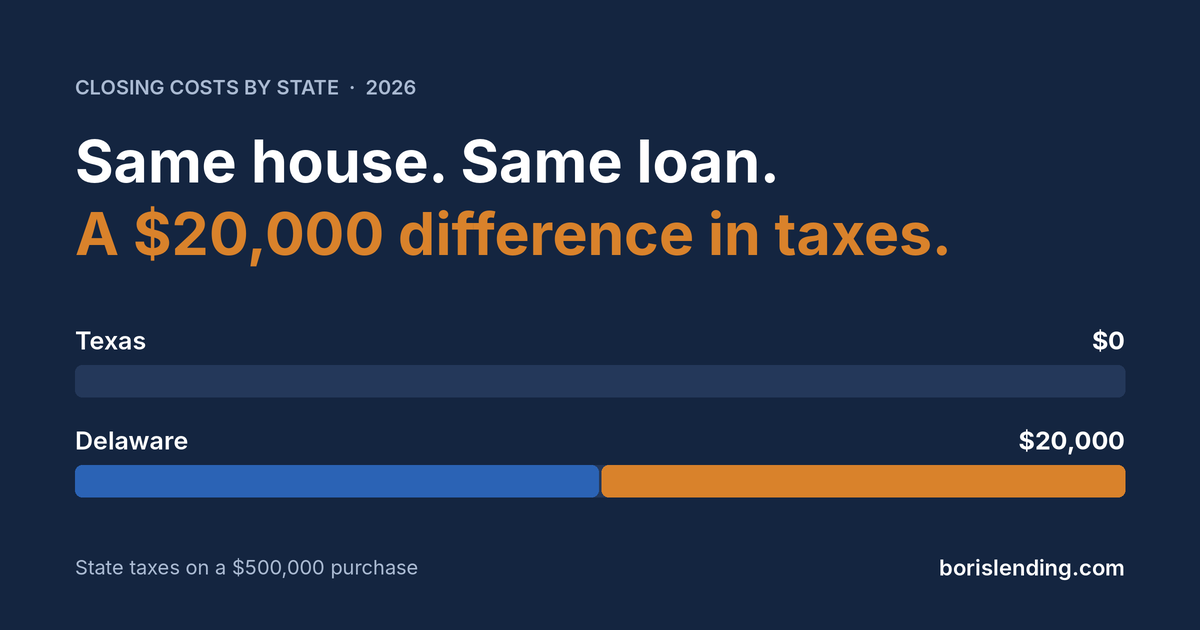
Two buyers. Same $500,000 house, same 20% down, same loan, same rate. One closes in Texas and pays nothing in state transfer or mortgage taxes. The other closes in Delaware and writes a check for $10,000 in transfer tax alone, with the seller paying another $10,000.
Same house. Same loan. A five-figure difference that has nothing to do with the lender.
That's the part of closing costs most articles skip. They give you a national average, tell you to budget "2% to 5%," and move on. The national average is close to useless if you're buying in DC, Delaware or New York, and it overstates things if you're buying in Missouri or South Dakota. Where you buy matters more than almost anything else on the closing statement.
Here's what the numbers actually look like, why they vary so much, and what you can do about it.
What "closing costs" actually means
Closing costs fall into four buckets:
- Lender costs. Origination or underwriting fees, and any points you choose to pay to lower your rate. These depend on the lender and the deal, not the state.
- Third-party costs. Appraisal, credit report, title search, title insurance, settlement or attorney fees, survey where required. Title insurance rates are set or regulated by state, so these vary somewhat.
- Government costs. Recording fees, transfer taxes and, in a handful of states, a tax on the mortgage itself. This is where the big state-to-state differences come from.
- Prepaids and escrow. Your first year of homeowners insurance, a few months of property taxes and insurance for the escrow account, and interest from closing to the end of the month. These aren't really costs of the loan; they're bills you'd pay anyway, just collected up front.
When you see a "closing costs by state" number, ask which buckets it includes. Most published averages, including the one below, cover title, settlement, recording and transfer taxes. They don't include lender fees or prepaids, so your actual cash to close will be higher.
The national picture
LodeStar Software, which produces closing cost quotes for lenders and title companies, analyzed more than 620,000 purchase quotes from 2025. Their national average came to $4,528, or 1.04% of the sales price. Take out recording fees and transfer taxes and the average drops to $2,993. In other words, about a third of the typical bill is government, and in some states it's far more than that.
The most expensive places to close in 2025, by average dollars:
| Average closing costs | |
|---|---|
| Washington, DC | $13,836 |
| Delaware | $12,707 (3.06% of price, the highest in the country) |
| New York | $12,418 |
| Maryland | $9,486 |
| Vermont | $9,164 |
And the least expensive: South Dakota ($1,386), Iowa ($1,541) and Missouri ($1,748).
Notice what the top five have in common. It isn't home prices; California and Hawaii have far higher prices and don't make the list. It's taxes on the transfer, the mortgage, or both.
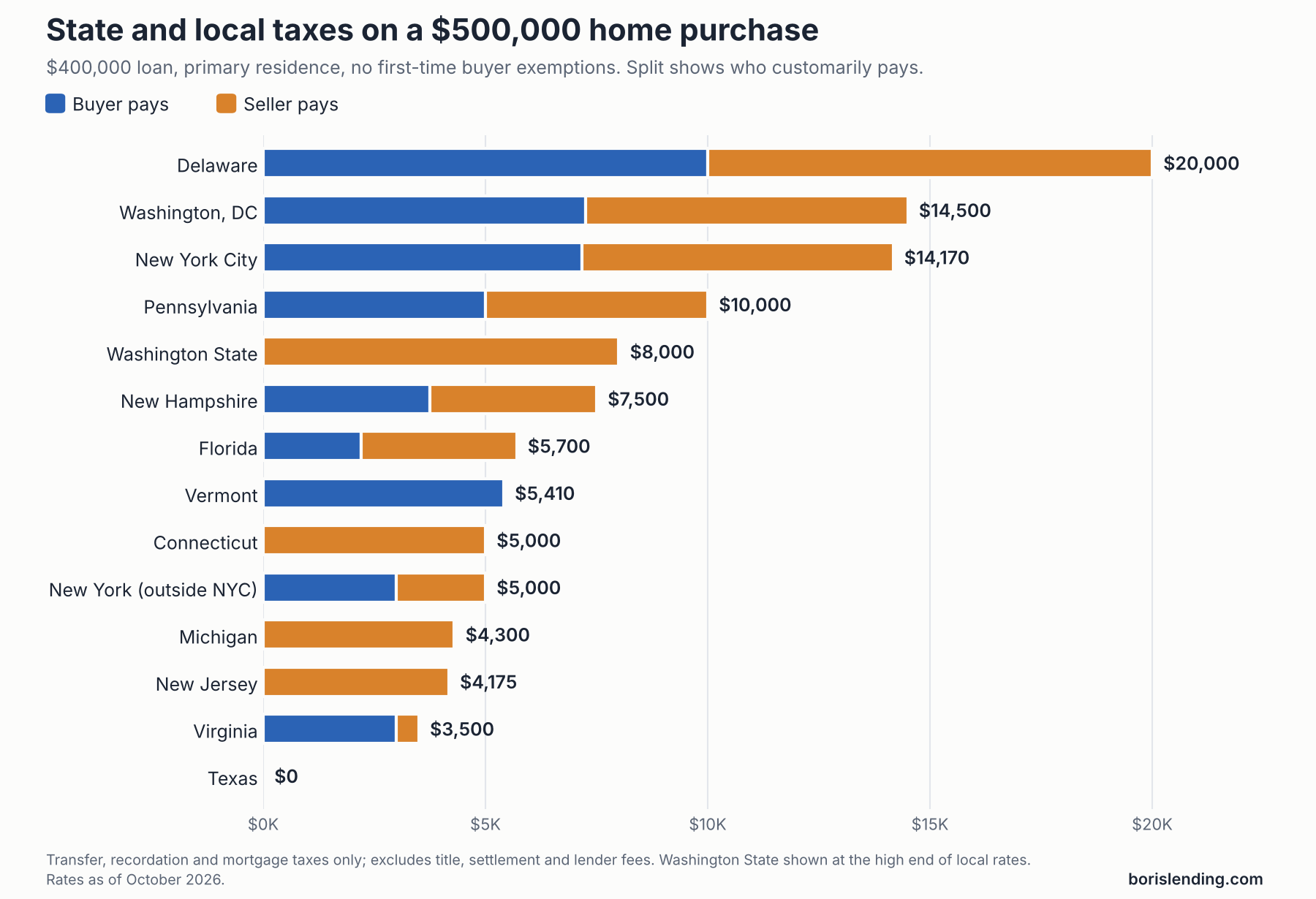
Why the expensive states are expensive
LodeStar also ranked states by how much of the price goes to recording fees and transfer taxes. The states below are in that order, most expensive first. Washington is at the end for a different reason: its tax is large, but the seller pays it.
Delaware
Delaware's transfer tax is 4% of the price in most of the state, the highest in the country. By default buyer and seller split it equally, 2% each. On a $500,000 home that's $10,000 per side.
First-time buyers get some relief. The state knocks 0.5% of the price off the buyer's share, counting up to $400,000 of price, so up to $2,000 back. Counties also exempt first-time buyers from the county tax on the first $400,000. It doesn't make Delaware cheap, but on a $400,000 home it's real money.
Vermont
In Vermont the buyer pays the transfer tax. For a primary residence it's 0.5% on the first $200,000 and 1.47% on the rest (that includes a clean-water surcharge). On a $500,000 home that's $5,410, all on the buyer. Second homes and investment properties pay 3.62% on the amount over $200,000.
New York
New York hits you twice: once on the deed, and once on the mortgage.
The state transfer tax is 0.4%, and in New York City there's a city transfer tax on top (1% at $500,000 or less, 1.425% above). The seller customarily pays those.
The buyer pays the mortgage recording tax, which is the one people don't see coming. Outside New York City it runs about 0.75% to just over 1% of the loan, depending on the county. In the city it's 1.8% on loans under $500,000 and 1.925% at $500,000 and up. On a $400,000 loan in Queens, that's about $7,170, before title insurance or anything else. And because it's a tax on the loan, it hits refinances too.
Then there's the mansion tax. Buy a home for $1 million or more anywhere in New York State and the buyer pays 1% of the full price. In New York City the rate climbs with the price: 1% from $1 million, 1.25% from $2 million, 1.5% from $3 million, and up to 3.9% at $25 million. It's a cliff, not a slope. A $999,000 apartment pays nothing; a $1,000,000 apartment pays $10,000. That's why you see so many listings priced just under the line. And at $3 million and up, the seller's state transfer tax in the city rises from 0.4% to 0.65%.
This is where a CEMA (Consolidation, Extension and Modification Agreement) earns its keep. Instead of paying off the old loan and recording a new one, the existing mortgage is assigned to the new lender and you only pay mortgage tax on the new money. On a refinance that can save thousands. On a purchase it can work too, if the seller's lender cooperates and the seller agrees to assign their mortgage, which takes planning before you're in contract, not the week before closing. Not every lender offers CEMAs.
Washington, DC
DC has the highest average closing costs in dollars. It charges two separate taxes on a sale, each at the same rate: 1.1% of the price under $400,000, and 1.45% of the full price at $400,000 or above. That threshold isn't graduated. A $399,000 home pays 1.1% on everything; a $400,000 home pays 1.45% on everything. By custom the buyer pays the recordation tax and the seller pays the transfer tax.
On a $500,000 home that's $7,250 for the buyer and $7,250 for the seller.
The relief valve: DC cuts the buyer's recordation tax to 0.725% for qualifying first-time buyers who will live in the home, within price and income limits that reset every October. On a $500,000 home that's $3,625 back in your pocket. The limits are generous enough that plenty of professionals buying their first place qualify, and plenty of them never hear about it until closing. Ask early.
Pennsylvania
Pennsylvania charges a 1% state realty transfer tax, and most municipalities and school districts add another 1%. Buyer and seller customarily split the total, so 1% each on a typical purchase. Philadelphia raised its rate in July 2025, and the combined tax there is now 4.578%. On a $500,000 Philadelphia home, that's $22,890, split down the middle.
Maryland
Maryland's state transfer tax is 0.5%, and then the counties add their own transfer and recordation taxes, which in some counties add up to more than the state's share several times over. All in, Maryland closings often carry 1% to 2% of the price in government charges, and by custom buyer and seller split them.
The detail worth knowing: for a first-time Maryland homebuyer buying a home they'll live in, the state transfer tax is cut in half, to 0.25%, and the law puts that remaining share on the seller. Many counties also offer first-time buyer reductions on their portion. It's a meaningful savings that your agent and settlement company should catch, but it's worth confirming it's on your estimate.
Florida
Florida is one of the few states that taxes the mortgage itself, on top of the deed. There are three taxes:
- Documentary stamps on the deed: 0.70% of the price, usually paid by the seller (Miami-Dade has its own rate).
- Documentary stamps on the note: 0.35% of the loan amount, paid by the borrower.
- Intangible tax on the mortgage: 0.2% of the loan amount, paid by the borrower.
On a $400,000 loan that's $2,200 in taxes just for borrowing the money. The last two apply to a refinance as well, which is why Florida refinances are noticeably more expensive than in neighboring states. If you're refinancing in Florida, factor that into your break-even math.
New Hampshire
New Hampshire charges 0.75% to the buyer and 0.75% to the seller, 1.5% in total. On a $500,000 home that's $3,750 each. It surprises people moving up from Massachusetts, where the buyer pays no transfer tax at all.
Virginia
Virginia's recordation tax applies to both the deed and the deed of trust, and by custom the buyer pays both: 0.25% to the state plus up to another third of that to the locality. On a $500,000 purchase with a $400,000 loan, the buyer's share runs about $3,000. The seller pays a separate grantor tax of 0.1%, and in Northern Virginia an additional 0.1% regional fee. More on Northern Virginia specifics on my Northern Virginia page.
Washington State
Washington's real estate excise tax is graduated: 1.1% of the price up to $525,000, then higher rates in brackets above that. Most cities add another 0.25% to 0.5%. The seller pays. On a $500,000 sale, that's $6,750 to $8,000. It doesn't touch the buyer's cash to close, and Washington doesn't appear near the top of LodeStar's rankings, which suggests their figures mostly reflect what buyers pay. But it shapes how sellers price and how they negotiate concessions.
Who pays: custom vs. contract
Every state has a custom for who pays what. In New Hampshire and Maine the transfer tax is split by law or long practice. In Michigan and New Jersey the seller pays. In Vermont and Tennessee the buyer does. In Delaware and Pennsylvania it's split.
But custom is just the starting point. Who pays is set by your contract, and in a slower market it's negotiable. A seller who needs to move may agree to pay the buyer's half of the transfer tax. A buyer in a multiple-offer situation may offer to pay the seller's. Either way, it's real money and it belongs in the negotiation, not discovered on the closing statement.
How to bring closing costs down
Some of this you can't change. The state's tax is the state's tax. But there's more room than most buyers realize:
- Find out if you qualify as a first-time buyer. DC, Maryland and Delaware all reduce transfer or recordation taxes for first-time buyers, and many counties and programs follow suit. The definition varies. In Maryland it means you've never owned a Maryland home you lived in, so someone relocating from Virginia can qualify. For many other programs it means you haven't owned a home in the past three years. Ask before you sign the contract.
- In New York, plan for a CEMA early. It needs to be in the conversation before you're in contract on a purchase, and it's a standard question on any refinance.
- Negotiate the split. Seller credits and transfer tax splits are both fair game. Your agent should be able to tell you what's realistic in your market.
- Compare lender fees line by line, not just the rate. The government charges will be the same no matter which lender you choose. The lender's own fees won't. Ask for estimates on the same day, without points, and compare them side by side. APR won't tell you much.
- Weigh a lender credit carefully. A slightly higher rate in exchange for a credit toward closing costs can make sense if you're likely to move or refinance within a few years. It rarely makes sense if you're staying put for a long time. That's a conversation to have once the deal has specifics.
- Don't confuse prepaids with costs. Escrow deposits and prepaid insurance aren't fees. They're your money, collected early. Lowering them doesn't make the house cheaper.
State taxes on a $500,000 home: all 50 states and DC
The table below shows the state-imposed taxes on a $500,000 purchase with a $400,000 loan (20% down), primary residence, buyer not claiming any first-time buyer exemption. It covers transfer, deed, recordation and mortgage taxes. It does not include recording fees, title insurance, settlement fees or lender costs.
Where a county or city adds a meaningful tax of its own, it's in the notes. "Customary payer" is the local norm; your contract decides.
| State | Transfer / deed tax (total) | Customary payer | Tax on the mortgage (buyer) | Notes |
|---|---|---|---|---|
| Alabama | $100 | Buyer | $600 | Deed tax applies only to the price minus the mortgage when both record together |
| Alaska | None | – | None | |
| Arizona | None | – | None | Flat $2 affidavit fee |
| Arkansas | $1,650 | Negotiable | None | |
| California | $550 | Seller | None | Many cities add their own tax (SF, LA, Oakland, Berkeley, others) |
| Colorado | $50 | Negotiable | None | |
| Connecticut | $5,000 | Seller | None | 0.75% state plus 0.25% municipal; some towns charge 0.5% |
| Delaware | $20,000 | Split | None | 4% total in most areas; first-time buyers get a state credit and a county exemption |
| District of Columbia | $14,500 | Split ($7,250 each) | None | Buyer's recordation tax drops to 0.725% for qualifying first-time buyers |
| Florida | $3,500 | Seller | $2,200 | Note stamps 0.35% plus intangible tax 0.2% of the loan |
| Georgia | $500 | Seller | $1,200 | Intangible tax 0.3% of the loan |
| Hawaii | $500 | Seller | None | $750 if the buyer doesn't qualify for the homeowner's exemption; higher rates above $600K |
| Idaho | None | – | None | |
| Illinois | $750 | Seller | None | Chicago adds 0.75% for the buyer ($3,750) and 0.3% for the seller |
| Indiana | None | – | None | Small sales disclosure fee |
| Iowa | $799 | Seller | None | |
| Kansas | None | – | None | |
| Kentucky | $500 | Seller | None | |
| Louisiana | None | – | None | New Orleans charges a flat fee |
| Maine | $2,200 | Split | None | |
| Maryland | $2,500 | Split | None | County transfer and recordation taxes add much more; first-time buyers get a break |
| Massachusetts | $2,280 | Seller | None | Barnstable County is higher ($3,240) |
| Michigan | $4,300 | Seller | None | 0.75% state plus 0.11% county |
| Minnesota | $1,650 | Seller | $920 | Mortgage registry tax 0.23% of the loan |
| Mississippi | None | – | None | |
| Missouri | None | – | None | |
| Montana | None | – | None | |
| Nebraska | $1,660 | Seller | None | Rate rose to $3.32 per $1,000 in July 2026 |
| Nevada | $1,950 – $2,550 | Negotiable | None | Higher in Clark County |
| New Hampshire | $7,500 | Split ($3,750 each) | None | |
| New Jersey | $4,175 | Seller | None | Seller also pays a 1%–3.5% fee on sales over $1 million |
| New Mexico | None | – | None | |
| New York | $2,000 | Seller | ~$3,000 – $4,200 | Depends on county; NYC adds a 1% city transfer tax and its mortgage tax is about $7,170 on this loan; buyer pays a 1%+ mansion tax at $1M+ |
| North Carolina | $1,000 | Seller | None | A few coastal counties add 1% |
| North Dakota | None | – | None | |
| Ohio | $500 – $2,000 | Seller | None | Depends on county |
| Oklahoma | $750 | Seller | $400 | Mortgage tax 0.1% of the loan |
| Oregon | None | – | None | Washington County charges 0.1% |
| Pennsylvania | $10,000 | Split | None | 1% state plus typically 1% local; Philadelphia totals 4.578% |
| Rhode Island | $3,750 | Seller | None | Rate rose in October 2025; higher rate on the portion above $824K |
| South Carolina | $1,850 | Seller | None | |
| South Dakota | $500 | Seller | None | |
| Tennessee | $1,850 | Buyer | $458 | |
| Texas | None | – | None | |
| Utah | None | – | None | |
| Vermont | $5,410 | Buyer | None | Primary residence rate; second homes pay more |
| Virginia | $1,667 + $500 | Buyer / Seller | $1,333 | Buyer pays recordation on deed and loan; seller pays grantor tax; Northern Virginia adds $500 |
| Washington | $6,750 – $8,000 | Seller | None | 1.1% state plus 0.25%–0.5% local |
| West Virginia | $1,650 | Seller | None | Some counties charge more, up to $2,750 |
| Wisconsin | $1,500 | Seller | None | |
| Wyoming | None | – | None |
Rates as published by each state as of October 2026. Local rates vary, and taxes change. Your settlement company or title agent will calculate the exact figures for your transaction.
Final Thoughts
Closing costs aren't one number. They're four different kinds of charges, and the biggest swing between states comes from the one your lender doesn't control: taxes.
That's exactly why it pays to know them before you're in contract. A first-time buyer exemption in DC or Maryland, a CEMA in New York, a negotiated split in Delaware or Pennsylvania: none of those happen by accident. They happen because someone asked early enough to do something about it.
When you're comparing lenders, compare the parts lenders control. When you're budgeting for the house, budget for the parts they don't. And if you want to walk through what a purchase would actually cost in your state, before you've fallen in love with a house, that's the conversation I like to have.
Feel free to reach out at 312-296-4175 or connect@borislending.com. I'm here to help you navigate the process and make the right decisions. I lend in all 50 states and I am never too busy for your referrals!
Sources: LodeStar Software Solutions, 2025 Purchase Mortgage Closing Cost Data Report (April 2026), as reported by Realtor.com and HousingWire; state revenue departments and statutes, including the DC Office of Tax and Revenue, Delaware Division of Revenue, Maryland Tax-Property Code, New York State Department of Taxation (Form MT-15), New Jersey Division of Taxation, Vermont Department of Taxes, Washington State Department of Revenue, Nebraska Department of Revenue, City of Philadelphia and City of Chicago. Rates checked October 2026.

Boris ChernerMortgage Loan Officer, NMLS #1579104, Capital Bank Home Loans. In mortgage lending since 1997, licensed in all 50 states. More about Boris.