

Price Reduction vs. Buydown: Which One Helps the Buyer More?
When a home has been sitting on the market, the automatic move is usually a price cut. Sometimes, that makes perfect sense. But if the buyer’s real hurdle is the monthly payment, a price reduction might actually be your weakest tool.
Let’s look at a simple example to see why.
The Scenario
- List Price: $650,000
- Down Payment: 20% (with a 740 credit score)
- Starting Loan Amount: ~$520,000
- The Seller’s Offer: Willing to contribute $30,000 to close the deal.
The question isn’t simply, “Can we reduce the price?” The better question is, “What is the smartest way to use that $30,000?”
The answer drastically changes the buyer’s monthly cash flow. Here are the three ways to slice it.
Option 1: The $30,000 Price Reduction
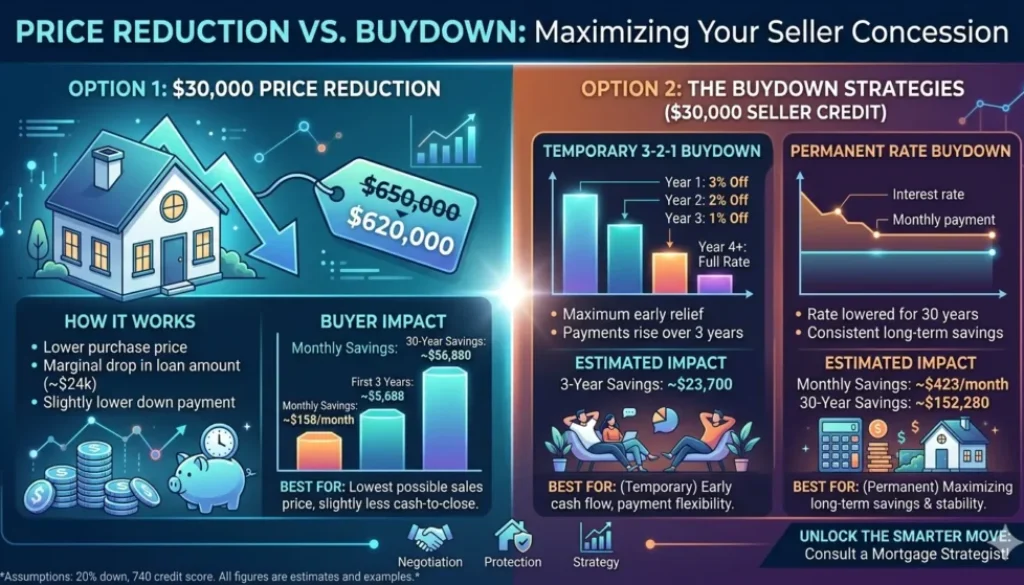
Lowering the price from $650,000 to $620,000 sounds like a massive win. Emotionally, it is. Mathematically? It might underwhelm you.
Because the buyer is putting 20% down, the loan amount doesn’t drop by the full $30,000—it only drops by $24,000. Depending on the final interest rate, this only lowers the monthly principal and interest payment by roughly $158 per month.
- Monthly Savings: ~$158/month
- First 3 Years: ~$5,688 total savings
- 30-Year Savings: ~$56,880 total savings
While helpful, it’s far from the most powerful use of the seller’s money.
Option 2: The 3-2-1 Temporary Buydown
A 3-2-1 temporary buydown structure gives the buyer massive payment relief during the first three years by artificially lowering the interest rate:
- Year 1: Rate is 3% lower than the note rate
- Year 2: Rate is 2% lower than the note rate
- Year 3: Rate is 1% lower than the note rate
- Year 4+: Returns to the full note rate
In this scenario, the estimated cost of the buydown is roughly $23,700. The buyer gets every penny of that used as front-loaded payment relief over those first 36 months.
The Tradeoff: Compared to the $5,688 saved in the first three years of a price reduction, this is a massive short-term win. However, after Year 3, the benefit completely vanishes. It’s an incredible tool for short-term breathing room, but it offers zero long-term savings.
Option 3: The $30,000 Permanent Buydown
Instead of temporarily subsidizing the rate, a permanent buydown uses the $30,000 seller credit to buy down the interest rate for the entire 30-year life of the loan.
Depending on current market pricing, using $30,000 permanently could drop the buyer’s monthly payment by roughly $423 per month.
- Monthly Savings: ~$423/month
- First 3 Years: ~$15,228 total savings
- 30-Year Savings: ~$152,280 total savings
When you look at the 30-year horizon, the permanent buydown saves the buyer nearly $100,000 more than a standard price reduction.
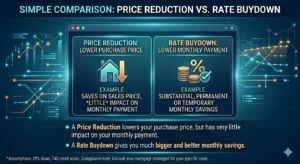
Side-by-Side Comparison
| Strategy | Monthly Benefit | First 3 Years Impact | 30-Year Total Savings | Best Use Case |
|---|---|---|---|---|
| $30,000 Price Reduction | ~$158 / month | ~$5,688 | ~$56,880 | Buyer wants a lower purchase price or slightly lower down payment. |
| 3-2-1 Temporary Buydown | Varies by year (Highest in Yr 1) | ~$23,700 | Temporary benefit only | Buyer wants maximum short-term cash flow/breathing room. |
| $30,000 Permanent Buydown | ~$423 / month | ~$15,228 | ~$152,280 | Buyer wants the highest long-term monthly savings. |
Final Thoughts
A price reduction feels good because everyone understands it. But as the numbers show, it rarely gives the buyer the biggest boost in monthly affordability.
The smartest negotiation isn’t always asking the seller to drop the price. It’s asking, “How can we structure this concession to create the highest ROI for the buyer?” That is where true mortgage strategy comes into play. Feel free to reach out to me at 312-296-4175 or email me at connect@borislending.com. I’m here to help you navigate the process and make the right decisions. I lend in all 50 states and I am never too busy for your referrals!!

I have been in the mortgage industry since 1997 and I understand the anxiety that comes with making the most expensive investment of a lifetime. My objective is to be your advisor, to educate you and to make the mortgage loan transaction as transparent and as stress-free as possible. I enjoy establishing personal connections and work mostly by referral. I thoroughly explain the process and available options, and guide my clients to make choices that best fit their needs and financial goals. Once the underwriting begins I communicate regularly and keep my clients apprised of the loan status from the beginning through the end. My relationship with clients does not end at the closing table. You are my client for life and I am always available to answer your questions and provide you with guidance.